
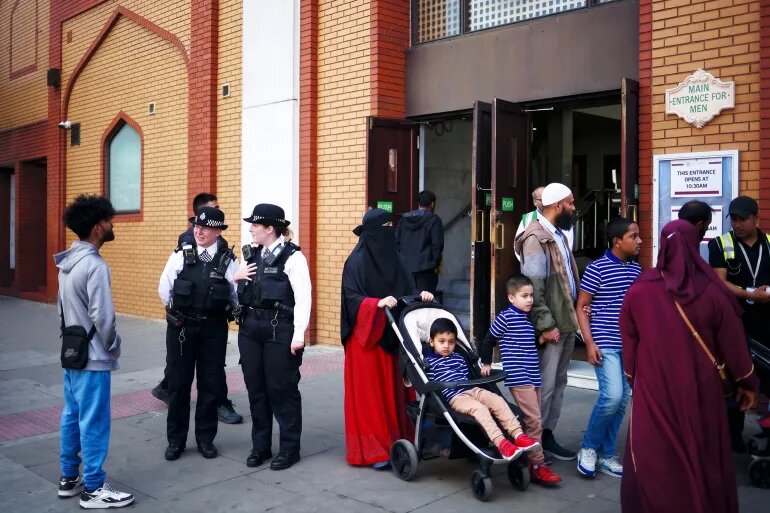
AhlulBayt News Agency (ABNA): The publication of guidelines by British police bodies on how to deal with religious communities has sparked political controversy. These guidelines advise police officers to consider cultural considerations when interacting with Muslims of the opposite sex and, in some cases, to consider assigning officers of the same sex to handle matters.
The British newspaper The Telegraph, in a report by Craig Simpson and Tim Sigsworth, wrote that these guidelines advise officers to dress modestly and in accordance with cultural considerations, refrain from entering areas designated for the opposite sex in mosques and Muslim homes, and consider cultural sensitivities when engaging in verbal or physical contact with individuals of the opposite sex.
These recommendations are presented in a document titled "National Guidance on Engaging with Faiths," which was drafted by the National Police Chiefs' Council in cooperation with the College of Policing. The purpose of preparing this guidance is to provide practical instructions to help police officers and staff engage with the diverse religious communities in Britain.
The document states that when interacting with individuals of the opposite sex, whether in physical contact or verbal conversation, cultural considerations must be taken into account. It is also emphasized that in some situations, using an individual of the same sex can be the most appropriate option for interacting with a Muslim.
Detailed Recommendations on How to Deal with Muslims
This guidance asks police officers, when visiting mosques or Muslim homes, to dress modestly, remove their shoes or cover them, maintain calm and respect, refrain from using dogs, and not disturb people while they are praying.
Officers are also advised to observe the proper manner of handling Qurans, Islamic books, and religious items, including prayer rugs and rosaries, during searches.
According to The Telegraph, the section on Islam in this guidance is longer and more detailed than the sections dedicated to the 22 other religions and beliefs addressed in the document. This section also has a separate recommendation on how to report hate crimes against Muslims. An issue that, according to this newspaper, which is close to the conservative right, has no similar instruction in the sections on other religions.
Criticism of the Guidelines by Right-Wing Political Figures
These recommendations have met with criticism from some political circles in Britain. Nigel Farage, leader of the far-right Reform UK party, described these guidelines as outrageous and claimed that this document is, in his words, further evidence of the existence of two different systems for enforcing the law in Britain.
He also said that the police should not go too far in observing cultures that he calls misogynistic and backward. Farage called for the cancellation of this document and for those responsible for drafting it to be held accountable.
On the other hand, Chris Philp, shadow home secretary in the Conservative Party, said that such guidelines harm the performance of British police. He stressed that all individuals should be treated in the same way, regardless of their religion or skin color.
Philp called for the withdrawal of this guidance and claimed that treating individuals differently because of their beliefs conflicts with the principle of equality before the law.
The Guidelines Are Not Limited to Islam
However, this document is not solely dedicated to Islam and also includes recommendations on how to interact with followers of Judaism, Buddhism, Sikhism, Catholicism, and other religions.
For example, police officers are asked to observe the separation of men and women in some Orthodox Jewish synagogues. This means that male officers should not enter areas designated for women, and female officers should not enter areas reserved for men.
This guidance also advises women to dress modestly when visiting Buddhist temples.
The guidelines also address how to handle the bodies of deceased Muslims. According to this document, when conducting examinations related to deceased Muslim women, priority is given to female Muslim specialists. If such a possibility is not available, non-Muslim female specialists are the next priority; after that come male Muslim specialists and finally non-Muslim male specialists. This order shows the preferential hierarchy of the document, although exceptions are also permitted where necessary.
The Growing Controversy Over British Police Performance
The Telegraph claims that these developments come at a time when debate over double standards in police performance in Britain is increasing. However, the guidance cited by this newspaper is not a new document and was published in June 2025, that is, about a year and a half ago.
On the other hand, a spokesman for the National Police Chiefs' Council defended this guidance and stressed that the law is enforced equally for everyone and that religious and cultural considerations do not take priority over the law or police operational duties.
He added that the purpose of drafting these guidelines is to help officers understand different communities and build trust between the police and these communities. A matter that can encourage members of these communities to report crimes, cooperate with police investigations, and seek help when needed.
**************
End/ 345E



